
America 2030 at Tectonic Defense Summit
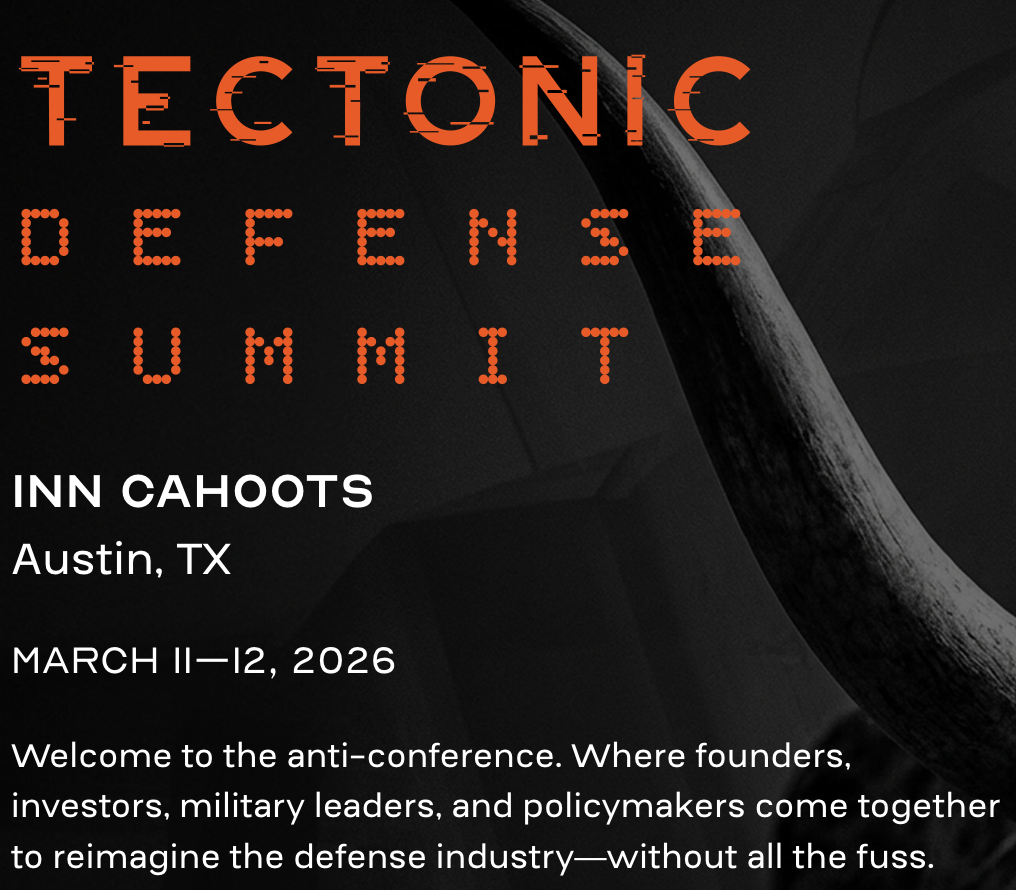
America 2030 is attending the Tectonic Defense Summit in Austin on March 11–12, 2026, a conference focused on defense innovation, autonomy, military modernization, and the capital formation behind next-generation defense and security companies. The event agenda includes themes directly relevant to the fund’s mandate, including autonomy at sea, drone defense, missile and munitions scaling, Indo-Pacific strategy, and growth capital for emerging defense primes.
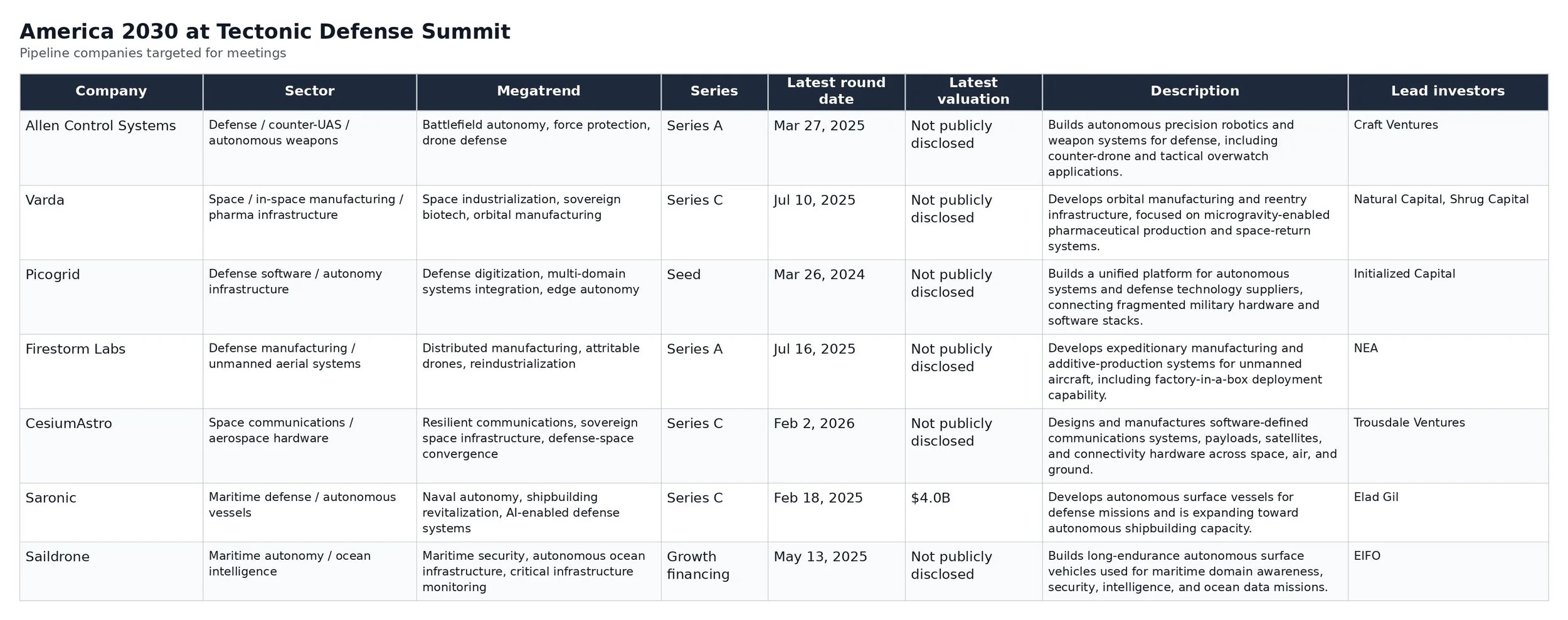
Our objective is to use the conference as a sourcing and diligence channel around pipeline companies that sit squarely inside the America 2030 thesis: autonomous defense systems, maritime autonomy, defense software infrastructure, and space-enabled communications and manufacturing. The targeted meeting set includes Allen Control Systems, Varda, Picogrid, Firestorm, CesiumAstro, Saronic, and Saildrone.
Why this conference matters
Tectonic is relevant because it compresses into one venue the operator, founder, investor, and procurement conversations that typically take months to source separately. For America 2030, that creates three forms of value: first, sharper underwriting on product maturity and deployment readiness; second, better insight into current financing conditions and investor syndicate quality; and third, direct content for LP distribution tied to the fund’s core resilience themes.
The specific pipeline names we are prioritizing represent a concentrated view of where we see durable spending tailwinds: counter-UAS and autonomous weapons systems, maritime unmanned platforms, defense software integration, and space infrastructure with dual-use relevance. In practical terms, this is one of the highest-density conference environments for companies that fit the America 2030 mandate.
Pipeline company summary
Company-by-company relevance to America 2030
Allen Control Systems is relevant because it sits directly in the counter-UAS and battlefield autonomy layer of the defense stack. Its recent $30 million Series A and Army-related traction suggest that the company is moving beyond concept-stage positioning into a more concrete deployment pathway. For us, the key diligence question is whether ACS can translate autonomous weapon-station capability into repeatable procurement and broad platform integration.
Varda is relevant as a more differentiated space infrastructure name. It extends the fund’s thesis beyond defense hardware into strategically important industrial capability: orbital manufacturing, reentry logistics, and pharmaceutical production in microgravity. Its July 2025 Series C materially expanded its capital base, and the company’s successful missions make it one of the more credible space-manufacturing platforms in the market.
Picogrid fits the software and systems-integration side of the thesis. Rather than building a single endpoint system, it is trying to become connective tissue across autonomous fleets, sensors, and defense subsystems. That matters because fragmented procurement environments often create real value for orchestration layers. The meeting objective is to assess whether Picogrid is becoming infrastructure or remains a useful but narrower integration tool.
Firestorm Labs addresses two themes we care about: attritable autonomous systems and distributed manufacturing. Its proposition is not just drones, but the ability to produce and support unmanned systems with far more flexible manufacturing architecture than traditional primes. The $47 million Series A is meaningful because the investor mix combines institutional VC with strategic defense alignment.
CesiumAstro is one of the stronger fits in space communications infrastructure. The February 2026 financing was large and signals that investors view the company as moving from technical proof into industrial scale. For America 2030, this is relevant because resilient communications and software-defined aerospace systems are increasingly central to both defense and commercial mission architecture.
Saronic is one of the clearest expressions of the maritime-autonomy thesis. Its $600 million Series C at a $4 billion valuation is one of the largest recent financings in defense technology, and the company is positioning beyond vessel manufacturing toward broader autonomous shipbuilding capability. The conference meeting is important because it can help us better understand production ambition, platform roadmap, and procurement maturity.
Saildrone remains highly relevant as a maritime autonomy and ocean-intelligence platform with defense and infrastructure-monitoring applications. The latest $60 million round was framed around bringing its technology to Europe and addressing maritime security needs, which reinforces the dual-use and geopolitical relevance of the platform. The central underwriting question is how quickly Saildrone can deepen defense penetration while preserving its broader data and monitoring utility.
What we want to learn at Tectonic
Across the target company set, the conference gives us an opportunity to test five underwriting questions.
We want to know where each company is on the spectrum from technical credibility to scaled deployment. Founders often present compelling capability claims; the conference environment lets us pressure-test those claims through live market feedback from operators, investors, and adjacent ecosystem participants.
We want better clarity on go-to-market and procurement reality. In defense and dual-use markets, technical merit is necessary but not sufficient. Companies that can navigate procurement cycles, integration constraints, and field deployment timelines will likely separate from those that remain perpetually “promising.”
We want to assess capital formation and syndicate quality. Several of these companies have raised meaningful rounds recently, but the composition of the investor base matters. A syndicate with durable follow-on support, strategic relevance, and sector depth can materially reduce financing risk.
We want better visibility into manufacturing and scaling constraints. This is especially relevant for Firestorm, Saronic, Saildrone, Allen Control Systems, and CesiumAstro, where valuation upside will depend not just on product quality, but on the ability to build, deliver, and support systems at meaningful volume.
We want to refine our view on portfolio fit and relative priority inside the pipeline. The conference should help distinguish which names deserve deeper work immediately, which should remain monitored, and where the best risk-adjusted opportunity may sit across defense software, maritime autonomy, and space infrastructure.
Sources
Tectonic Defense Summit event page — conference date and positioning.
Allen Control Systems Series A announcement — round size, date, company description, lead investor.
Varda Series C announcement — round size, date, description, lead investors.
Picogrid seed round announcement — round size, date, description, lead investor.
Firestorm Labs Series A announcement — round size, date, description, lead investors.
CesiumAstro Series C announcement — round size, date, description, lead investors.
Saronic Series C coverage — round size, date, valuation, lead investor, company description.
Saildrone financing announcement — round size, date, description, lead investor.
What is IPO CLUB
We are a club of Investors with a barbell strategy: very early and late-stage investments. We leverage our experience to select investments in the world’s most promising companies.
Disclaimer
Private companies carry inherent risks and may not be suitable for all investors. The information provided in this article is for informational purposes only and should not be construed as investment advice. Always conduct thorough research and seek professional financial guidance before making investment decisions.
IPO CLUB Research
The full research lives inside the Data Room
Company deep dives, quarterly valuations, and live allocations across Defense, Energy, AI Infrastructure, Robotics, Critical Minerals, and Space. Membership is free.
Enter the Data Room → For accredited investors