
Shield AI vs. Anduril

Short-Term pre-IPO FUND: Investing in defense technology through America 2030 allows accredited investors to participate in the resurgence of U.S. national security innovation. Learn more.
What Shield AI Actually Does
Shield AI is a U.S. defense-technology company building autonomous AI systems designed to operate in the most dangerous, GPS-denied, and communications-contested environments.
In plain terms: They’re teaching machines to think, navigate, and fight without human control when humans can’t safely go.
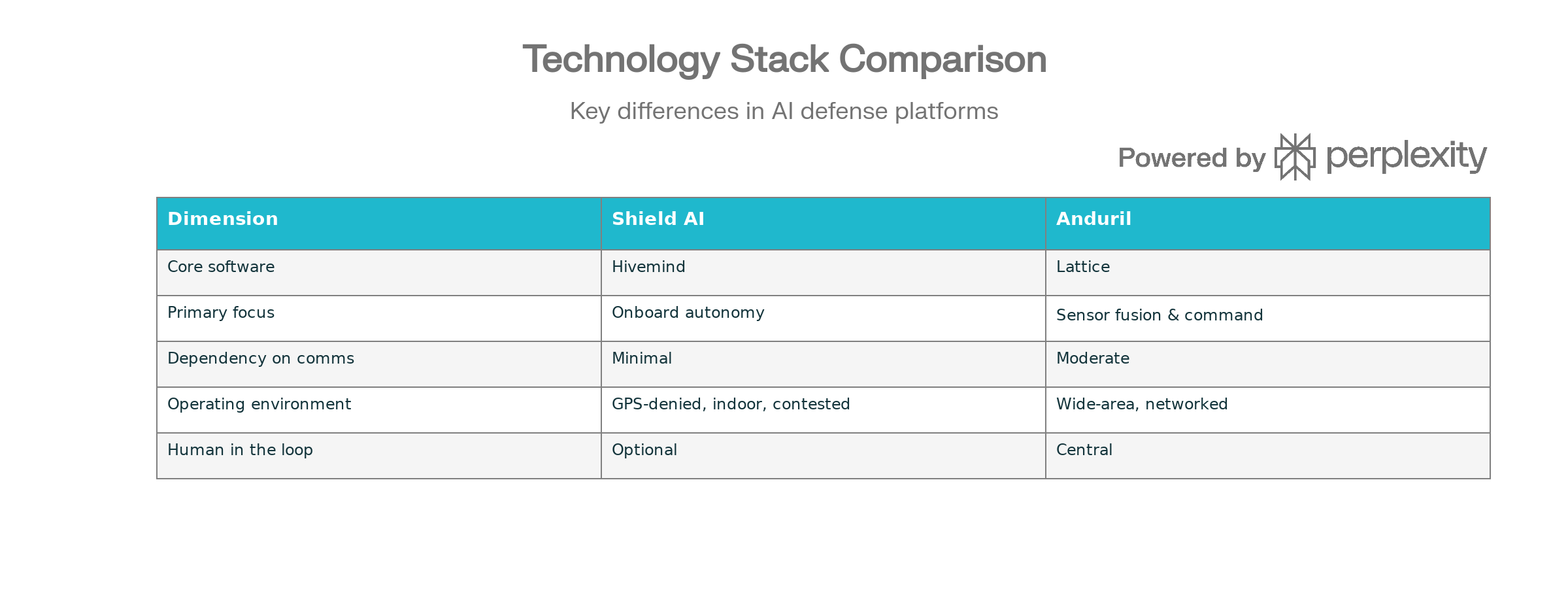
At the core of the company is Hivemind, its autonomy software stack.
Hivemind allows aircraft and other platforms to:
Navigate without GPS
Perceive and map unknown environments
Make mission decisions independently
Coordinate with other autonomous systems
This is not remote control. It’s onboard intelligence.
Key Products and Platforms
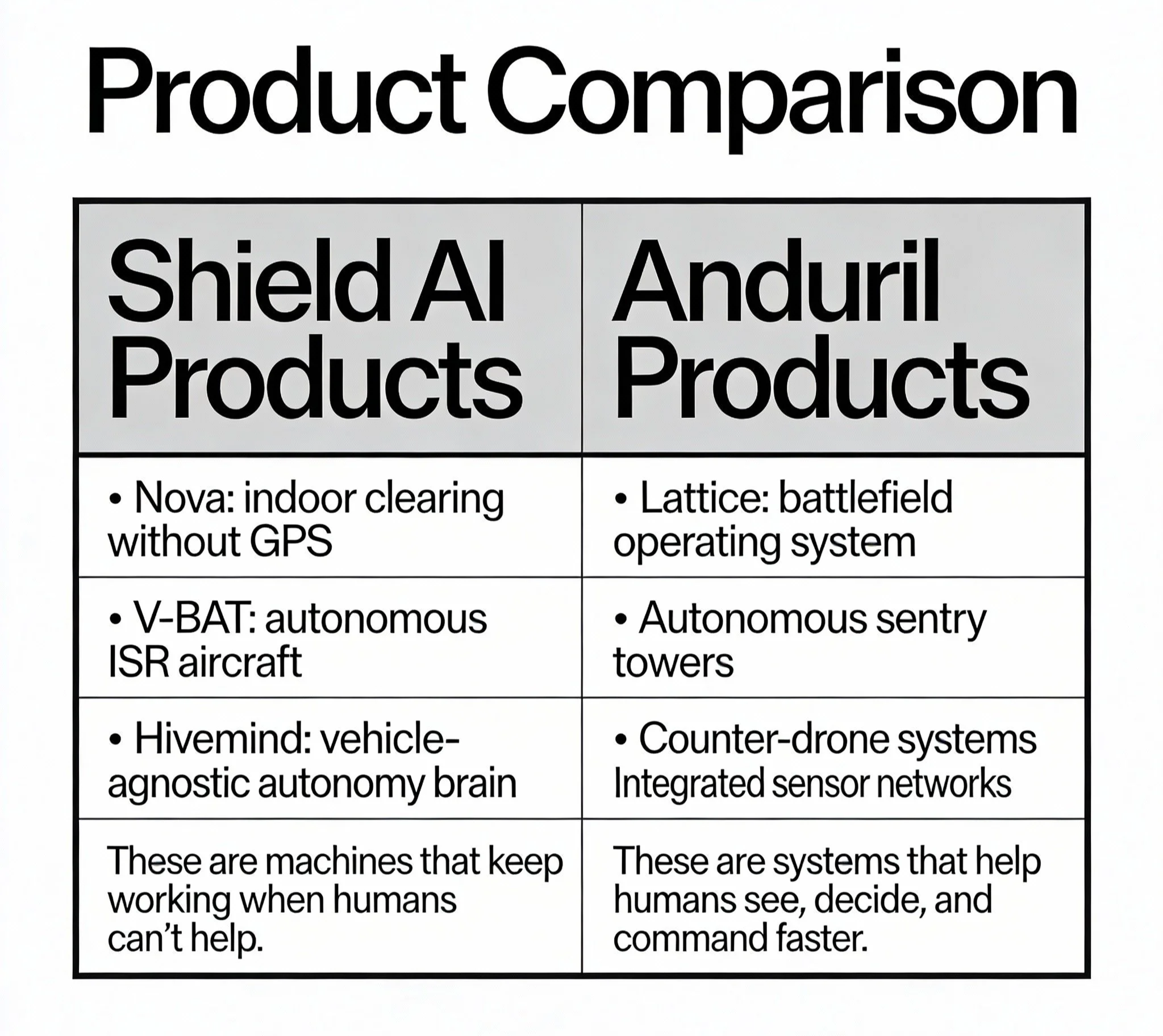
Hivemind Autonomy
The “brain.”
A hardware-agnostic AI system that can be deployed across different vehicles and missions.
Nova Drone
A small, indoor-capable drone used for room-clearing, tunnel inspection, and urban reconnaissance.
Already deployed by U.S. and allied forces.
V-BAT
A vertical takeoff and landing (VTOL) unmanned aircraft designed for longer-range missions from ships or austere locations.
Why Shield AI Matters
Modern warfare is changing.
Signals are jammed.
GPS is unreliable.
Human reaction time is too slow.
Therefore: Autonomy becomes a strategic necessity, not a nice-to-have.
Shield AI positions itself at the intersection of:
Artificial intelligence
National security
Real-world combat deployment
Few AI companies operate outside the lab. Shield AI does.
Customers and Credibility
Shield AI works with:
The U.S. Department of Defense
Allied militaries
Special operations units
This matters.
Defense adoption is slow, conservative, and unforgiving. Deployment signals trust.
The Bigger Picture
Shield AI isn’t just a drone company.
It’s an AI infrastructure company for defense, aiming to make autonomy as foundational to military operations as GPS once was.
If autonomy is the future of conflict, Shield AI wants to be the operating system.
Shield AI vs. Anduril
Shield AI builds the brain inside autonomous machines while Anduril builds the nervous system around the battlefield. Same war, different layers of the stack.
Core Philosophy
Shield AI: Autonomy at the Edge
Shield AI is obsessed with one problem.
What happens when humans are cut off?
No GPS.
No comms.
No joystick.
Therefore, the machine must:
Perceive
Decide
Act
On its own.
Autonomy is not a feature. It is the product.
Anduril: Decision Advantage at Scale
Anduril starts elsewhere.
The battlefield is flooded with sensors.
Humans can’t process it all.
Therefore, software must:
Fuse data
Highlight threats
Recommend actions
Coordinate responses
Anduril’s goal is command dominance, not vehicle independence.
Go-To-Market Strategy Comparison
Shield AI
Shield AI’s go-to-market strategy begins with elite operational units, where tolerance for experimental capability is higher and mission urgency outweighs procurement inertia.
Proves full autonomy in high-risk, denied, and GPS-contested environments
Focuses on extreme edge cases to validate reliability under combat stress
Expands horizontally across platforms once autonomy credibility is established (air, ground, maritime)
Strategic logic:
If autonomy works in the hardest environments, it becomes mission-critical and difficult to replace.
Anduril
Anduril’s strategy is built around integrated systems deployment at scale, bundling hardware platforms with proprietary software.
Sells platforms + software as a unified system
Targets replacement of legacy defense contractors
Scales vertically across bases, borders, and operational theaters
Strategic logic:
By owning the full stack and deployment footprint, Anduril positions itself as the default next-generation defense contractor.
Shield AI stock vs. Anduril stock — Private-Market Comparison
In the pre-IPO universe, “stock” refers to private valuations and fundraising performance, not publicly traded shares. Both companies are privately held but represent powerhouse valuations in the defense tech sector.
Shield AI’s valuation at $12B (current talks of round, February 2026) places it as one of the largest autonomous systems startups in defense but significantly below Anduril’s scale.
Anduril’s valuation at $60B (current talks of round, February 2026) more than 5x Shield AI’s, reflecting its broader platform strategy and deeper venture capital backing.
These figures are private values reported by funding rounds and reflect investor expectations rather than market prices.
Revenue & Contract Signals
Anduril reportedly reached ~$1 billion in revenue as of 2024, with contract value estimates in the low billions, supporting its premium valuation.
Public data on Shield AI revenue are less consistently reported, but one third-party estimate places 2024 revenue near $267 million, aligned with expanding contracts and international deployments.
Revenue differences help explain relative private valuations: Anduril’s broader platform suite and larger backlog implies greater near-term monetization potential, while Shield AI’s focus on autonomy software and mission execution suggests longer gestation toward recurring revenue.
Investor Profiles & Strategic Backing
Shield AI’s investor mix includes strategic defense partners like L3Harris and Hanwha, signaling industry alignment and potential integration pathways with existing primes.
Anduril’s backers include heavyweight VC firms (Founders Fund, a16z, General Catalyst), providing deep capital for scaling hardware and systems integration.
Risks from an Investment Perspective
Shield AI
Autonomy technology must prove reliability against military-grade edge cases before commanding premium multiples.
Smaller relative scale and narrower product set contribute to valuation dispersion among investors.
Anduril
Larger enterprise footprint increases complexity and execution risk, but also diversifies revenue streams.
A more mature contract pipeline and higher revenue base attract broader investor capital.
Implications for Pre-IPO Investors
From a private-market lens:
Anduril’s wider scale and revenue traction support its significantly higher private valuation, suggesting stronger near-term liquidity prospects if/when it approaches public markets.
Shield AI’s autonomy focus anchors its long-term strategic value, but its current valuation reflects both growth potential and execution risk tied to proving autonomous systems at scale.
This comparative view is neutral and summarizes private valuation, revenue indications, and investor signals — not investment advice.
(All numbers sourced from public funding reporting and private-market analyses.)
Competitive Reality (Critical Distinction)
Despite surface-level comparisons, Shield AI and Anduril are not direct competitors today.
They operate at different layers of the defense stack and are, in practice, complementary.
Anduril can:
Detect threats
Fuse sensor data
Assign missions and tasks
Shield AI can:
Execute those missions
Navigate denied environments
Operate autonomously without human intervention
Analogy:
Android OS vs. cellular network infrastructure.
Different layers. Same operational outcome.
Strategic Risk Profiles
Shield AI — Risk Profile
Autonomy is technically non-linear
Edge cases are frequent and unforgiving
Failure modes are often binary (works or doesn’t)
Upside:
If autonomy is proven at scale, Shield AI becomes structurally irreplaceable within the kill chain.
Anduril — Risk Profile
Systems integration complexity across domains
Exposure to defense procurement politics
High capital intensity for hardware manufacturing and deployment
Upside:
If scaling succeeds, Anduril becomes the default systems integrator for Western defense, analogous to a next-generation prime contractor.
Investing in defense technology through America 2030 allows accredited investors to participate in the resurgence of U.S. national security innovation. Learn more.
FAQ
Last updated:
What is the difference between Shield AI and Anduril?
Shield AI is an AI-autonomy company whose Hivemind software flies aircraft and drones without GPS or a remote pilot, while Anduril is a broader defense-hardware company building drones, counter-drone systems and its Lattice command software.
- Shield AI is focused on autonomy software and AI piloting.
- Anduril combines hardware with its Lattice operating system.
- Both supply the U.S. Department of Defense and allied militaries.
Is Shield AI or Anduril bigger?
Anduril is the larger company by private-market valuation, recently around $60 billion, versus roughly $12.7 billion for Shield AI.
- Anduril: approximately $60 billion.
- Shield AI: approximately $12.7 billion.
- Both remain private and are growing quickly.
Can I invest in Shield AI or Anduril before their IPO?
Both companies are private, and accredited investors can access pre-IPO shares through IPO CLUB via Single-Name SPVs or the America 2030 Fund.
- Access is limited to accredited investors.
- The typical minimum investment is $50,000.
- Availability depends on secondary supply and can change.
Which is the better pre-IPO investment, Shield AI or Anduril?
Neither is universally better; they carry different risk and return profiles, and this is not investment advice. Anduril is later-stage and more diversified, while Shield AI is more concentrated on autonomy.
- Anduril: larger, more diversified, later-stage.
- Shield AI: earlier, more concentrated on AI autonomy.
- See the article's risk comparison; both are accessible through IPO CLUB.
What is IPO CLUB
We are a club of Investors with a barbell strategy: very early and late-stage investments. We leverage our experience to select investments in the world’s most promising companies.
Sources
U.S. Department of Defense — Autonomy and Artificial Intelligence Strategy
Source: U.S. Department of Defense, February 2023Defense Innovation Unit (DIU) — Autonomy Portfolio & Operational AI Programs
Source: Defense Innovation Unit, 2022–2024Reuters — Coverage of Shield AI funding, contracts, and autonomous systems deployments
Source: Reuters, 2021–2024Reuters — Coverage of Anduril product launches, contracts, and valuation milestones
Source: Reuters, 2019–2024U.S. Air Force & U.S. Navy Program Offices — Autonomous systems testing, edge-environment operations, and ISR modernization
Source: U.S. Air Force / U.S. Navy, 2020–2024Center for Strategic and International Studies (CSIS) — AI, Autonomy, and the Future of Defense
Source: CSIS, 2021–2024Congressional Research Service (CRS) — Defense Primer: Artificial Intelligence and Autonomy
Source: Congressional Research Service, 2022–2024Financial Times — Defense technology modernization, contractor displacement, and Silicon Valley defense entrants
Source: Financial Times, 2020–2024NATO Allied Command Transformation — Autonomous Systems and Multi-Domain Operations
Source: NATO ACT, 2021–2023Company Primary Materials — Product documentation, public demonstrations, and official statements
Source: Shield AI; Anduril Industries, 2020–2024
Disclaimer
Private companies carry inherent risks and may not be suitable for all investors. The information provided in this article is for informational purposes only and should not be construed as investment advice. Always conduct thorough research and seek professional financial guidance before making investment decisions.
IPO CLUB Research
The full research lives inside the Data Room
Company deep dives, quarterly valuations, and live allocations across Defense, Energy, AI Infrastructure, Robotics, Critical Minerals, and Space. Membership is free.
Enter the Data Room → For accredited investors